
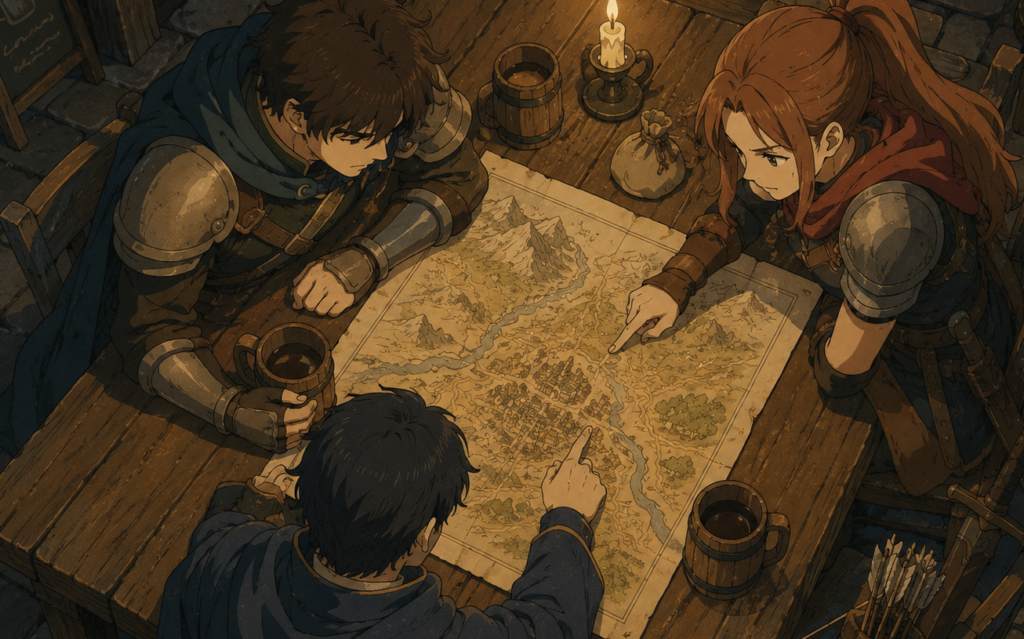
Sandbox campaigns are often presented as the ultimate form of player freedom. Yet many Game Masters struggle to make them work. Players feel lost, overwhelmed by choices, or unsure what to do next. Worse, your players may become bored and the campaign can start to feel like a slog. The truth is that a good sandbox is not a world without structure.
After several failed attempts and one successful long-running campaign, here are the lessons I learned and the things that worked for me.
Define the campaign theme
What is the theme of your campaign? Is it a lighthearted big adventure or is it more gritty and dark? Is it a Game of Thrones-esque kind of campaign or a chosen one to save the world? What is the mood, the genre you would like to explore? What kind of locations and biomes? There are no wrong answers but it is better to ask those questions to yourself before starting the campaign. Even better, during session 0, talk to your players about this and choose together what kind of campaign you all would like to do. It makes things easier to keep everyone engaged.
Create a central Hub
First you are going to need a safe place for the party where they can go back and forth. It can be a small village, a city or whatever you think of. The town should give them the possibility to rest like a tavern, gear up in shops, meet NPCs and find quests. We will go into details on how to make a city in another post. You don’t have to build the entire city and map it out for the first session. Just prepare a few locations the characters might speak with.
Give the party clear goals
This is the most important element of building a sandbox campaign and this is the main reason a lot of people failed, myself included. The party needs clear goals.
Don’t throw the characters in the sandbox and ask them what to do. Because most of the time there will be an awkward silence. Start as usual with a first quest. Ideally, it should be fun oriented. Keep the drama and tension for later. Hook your players and have fun first. When things will go wrong, the impact will be bigger.
At the end of the first quest, I like to lead with a goal the party has to reach. This has several purposes. First, you can build narrative arcs based on the goal and plan future story beats. Second, your players won’t feel lost. With the goal in mind, they can plan their course of action and they will have decisions to make to succeed. Your party having a goal and making sure it is clear for them is what will make things in motion.
In my current campaign, the goal of the party is to investigate a curse on the castle and how to break it. Once achieved, they will find something more about the story, giving them another goal to achieve before reaching the endgame. Players can also give their own goal to their characters, like seeking a magic weapon or learning something about their past.
One thing I also like doing is giving them side quests related to the main narrative arc. For example the party can learn something about the evil plan of the bad guys. I don’t always do that to avoid fatigue about the main narrative. Sometimes, a simple fun quest is all we need.
Prepare helping NPCs
The party will need friendly NPCs they can count on. It can be a mentor figure or an information gatherer and can become an ally or a friend over time. Anything you can think of. Prepare one or two NPCs that can help (you can add more later if you want). After some time, players will naturally seek out these NPCs for advice, quests, and roleplaying opportunities. This will help avoid the slog part when the party doesn’t know what to do next.
Those kinds of NPC are also great at telling and explaining the lore of your world to your players. But please, don’t turn this into a history lecture. Keep it simple. If the players are curious and hooked, they will ask questions themselves.
Build a meaningful sandbox
The big thing about sandbox is giving your players options and things to explore. So you need to give them a playground around the Hub. Something that worked for me was mapping the area. The Hub should be in the center of the area. This will give more options regarding exploration. Put points of interest on the map and don’t always name them. There is a ruined tower a few miles away from town, what could it be? Not always giving them information about the world will make them curious about it. They’ll even ask the ally NPC, we just talk about, if there is something to learn about that place.
Put several locations like that on the map and give the players clear goals. Now the players have meaningful choices to make. Speaking of which, your sandbox world doesn’t have to wait for the party to come to save the day. If something is ignored or not dealt with in time, hit them with the consequences. Allow downtime as well to avoid putting too much pressure.
Though, I would advise to start small first, you can always zoom out after. My starting area was a day travel around the city hub. After a year of gaming, the players only explored half.
Plan the endgame
All good things come to an end. You should decide as a GM when the campaign will end. For instance, defeating the evil dark lord, finding the legendary artifact before the bad guys, saving the princess or all three. Whatever you decide, the conditions needed for the campaign to end should be a meaningful conclusion for the party and their adventures. After that they can either enjoy retirement or start elsewhere (if you want to do another sandbox campaign with the same party).
At the end of the day, building a successful sandbox relies a lot on your players willing to explore one. One mistake I made is trying a sandbox game with people that enjoy linear games more. And it’s ok. So my final advice would be to discuss it with your players and see how they feel about it.